
Inside Furnished Finder’s human-centered approach to AI in customer support
Furnished Finder scaled customer support with Zendesk AI, with automation at 44 percent, while maintaining a human-centered approach. COO Cami Narino shares how the company empowered its team, is redefining roles, and continues to use AI to grow efficiently—without increasing headcount.
"Zendesk's impact was immediate. Within weeks, about 60 percent of our Landlord Tools support volume was being handled by our AI chatbot."
Cami Nariño
Chief Operating Officer - Furnished Finder
"I've always tried to lead with compassion. That shapes how our customer experience team approaches our clients and the role we play in their lives."
Cami Nariño
Chief Operating Officer - Furnished Finder
Company Headquarters
Austin, Texas
Year Founded
2014
Furnished Properties Listed
300,000+
Travelers seeking housing
6 Million+
44%
Reduction in inbound support requests
60%
Landlord Tools support volume automated
12%
Fewer contacts per customer
80%+
Combined customer satisfaction
Furnished Finder, a platform that connects traveling professionals with monthly furnished housing across all 50 states, operates in a category where every transaction is personal. The marketplace has scaled rapidly to more than 300,000 listings from 240,000 landlords in a few years, drawing six million unique travelers in search of monthly furnished housing each year.
Unlike many of its competitors, a large share of Furnished Finder’s property owners are individuals, not professional landlords. In fact, 83 percent of listings come from single-property landlords, and 65 percent are over the age of 55—many are retirees, first-time landlords, or homeowners monetizing a spare bedroom or second home. Some have turned to landlording out of necessity.
“Some of our clients may be facing financial challenges—things like losing their main source of income or the death of a spouse, some others are navigating what it means to become a landlord for the very first time,” says Cami Narino, Chief Operating Officer at Furnished Finder. “In many cases, the first interaction with our CX team is an opportunity for us to support someone at a critical moment in their life.”
“I’ve always tried to lead with compassion,” Narino adds. “That shapes how our customer experience team approaches our clients—and the role we play in their lives.”

Using AI to reduce support volume
Since its launch in 2014, Furnished Finder has grown quickly—from roughly 20,000 listings before 2020 to more than 300,000 today—and so has demand for support. By 2024, contact rates had climbed to 13 percent of the paid landlord base, with each customer averaging 1.55 support interactions.
Just two years ago, the team was operating on a legacy, homegrown ticketing system, relying on manual workflows and internal workarounds to keep up with that growth. In 2024, Furnished Finder began transitioning to Zendesk Support, marking its first step toward a more scalable CX operation.
Furnished Finder also offers a suite of Landlord Tools, including tenant screening, online rent payments, and other features designed to support seamless bookings and property management.
While this product set represents a smaller portion of overall revenue, it has historically generated a disproportionate share of support volume—largely driven by simple, repetitive inquiries. This growing demand has outpaced the core business, highlighting an opportunity to improve efficiency while maintaining a high standard of service.
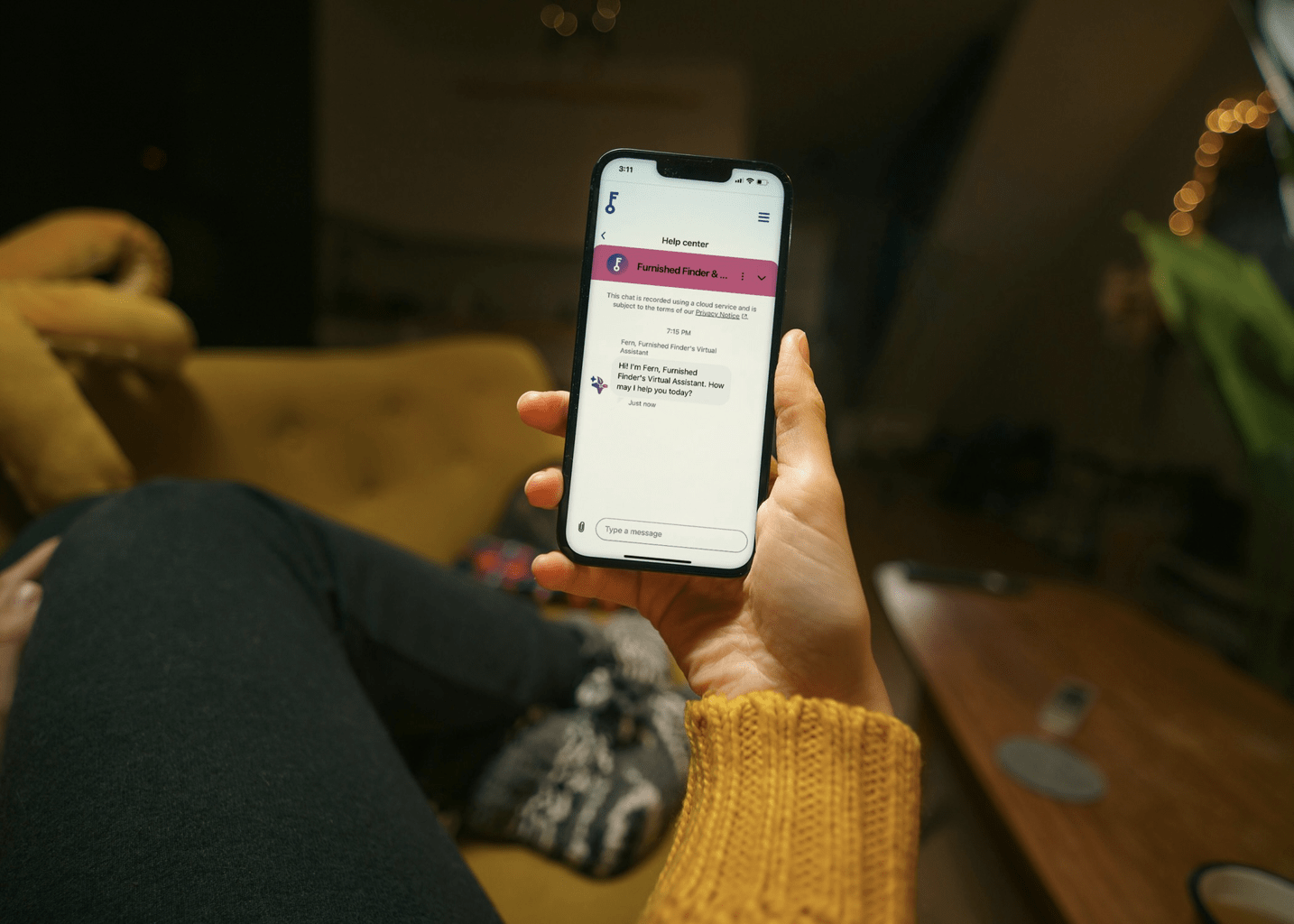
Furnished Finder took a multi-pronged approach to scaling support, launching a help center with Zendesk Guide to make it easier for users to find answers and resolve issues on their own, and deploying an AI-powered agent, Fern. The biggest shift came when the team embedded Fern directly into product pages in August 2025, meeting users where they were already taking action. By October 2025, more advanced AI chat capabilities were introduced, accelerating adoption.
Embedded directly into the product experience through Zendesk’s messaging layer, Fern guides users through common questions and workflows in real time. The company started the AI journey with their Landlord Tools queue, allowing the team to refine the experience before expanding to the full Furnished Finder platform.
“The impact was immediate,” Narino says. “Within weeks, about 60 percent of our Landlord Tools support volume was being handled by Fern.”
Routine issues—things like navigation questions or basic troubleshooting—can now be resolved instantly through the help center or Fern, without requiring a human agent. As the help center and AI expanded across both platforms, the combined impact became compelling.
Today, 44 percent of all inbound support requests are resolved through self-service—via help center articles and AI powered Fern conversations. Contact rates dropped from 13 to nine percent of the landlord base, and contacts per customer fell from 1.55 to 1.36, all while maintaining customer satisfaction above 80 percent.
Reframing AI as a people strategy
While these tools reduced tickets and sped up resolution times, they also introduced a new challenge.
“When our support team saw their workload decrease, they began to worry,” Narino says. “Their biggest fear was, ‘I’m not going to have a job here anymore.’”
Rather than treating AI purely as a cost-saving tool, Narino took a different approach.
“Any brand can lean heavily on cost reduction—it becomes a math equation,” she says. “The other side of the coin is, how do we take care of the people who have taken care of us?”
Narino met with her team to explain how their roles would evolve, reinforcing that AI would change work—not eliminate it.
“Our messaging continues to be clear and compassionate,” Narino says. “We continue to work with our team on upskilling and equipping them for this new era.”
Beyond immediate operational gains, this shift is expanding career pathways. As the team learns how to use AI in their day-to-day work, they’re building skills that open new opportunities for their future. In March 2026, Furnished Finder deepened that investment by providing ChatGPT licenses and plans to roll out hands-on training in prompting and AI-assisted workflows.
At the same time, the company continues to prioritize retaining and investing in high-performing talent—reallocating team members from routine inquiry resolution to more complex, high-value cases that require context, judgment, and emotional intelligence, where human support remains essential.
This shift is paired with clear expectations, as Furnished Finder actively upskills its team while reinforcing accountability for the quality of the experience they deliver.

Investing in people to improve CX
That people-first philosophy extends beyond support operations. Narino, a native of Colombia, has focused on building a female-forward workforce as the company has scaled.
“When you invest in women, you invest in a community,” she says.
Today, more than 200 employees in Latin America support Furnished Finder’s U.S. marketplace remotely across customer experience and sales.
Furnished Finder began building its Colombia-based team in 2017, and today that investment has evolved into a leadership pipeline—roughly 80 percent of leaders across customer-facing teams started as customer service representatives.
“It’s been a personal mission for me to create opportunities in a market where female unemployment remains high,” Nariño says. “That impact shows up not just at home, but in how our team shows up for our customers.”
For some team members, that growth has been transformational.
Aleja began her career in a BPO environment as a customer service representative. After joining Furnished Finder, she quickly advanced through leadership roles and is now Director of Customer Experience, leading a team of approximately 100 people.
Laura, who previously worked as a university professor with limited career mobility, joined to help build an internal sales quality function. She successfully scaled that work into a broader CX quality program and now leads those efforts as a manager. She has since relocated to Austin, Texas, and works from the company’s headquarters.
“These are the stories that matter most,” Narino says.
Restructuring the role of support
That investment in people shows up in how Furnished Finder is evolving its support model. By equipping both users and agents with better tools—including Zendesk AI and a robust help center—the company is reducing routine inquiries and freeing up employees to focus on work that requires more context and judgment.
This includes areas like AI training and quality assurance, business process improvement, tooling optimization, and trust and safety, work that requires deeper critical thinking.
“Our goal is to use AI to support both our users and our team—handling low-risk, low-complexity interactions so our agents can focus where they add the most value,” Narino says.
Growing without adding headcount
This shift has changed how Furnished Finder approaches growth. Instead of scaling support linearly with demand, the company is increasing the capacity of its existing team through automation and improved workflows in Zendesk.
“We want to retain our team while supporting a growing number of users,” Narino says.
Today, each customer service representative supports a coverage ratio of approximately 4,200 landlords per rep. As AI automation handles more low-complexity interactions, that coverage ratio continues to expand without proportional headcount growth.
The goal is to continue the rapid growth of listing supply and tenants using our platform incrementally each year—without increasing headcount. AI is a key part of what makes that possible.
Defining success in an AI-driven model
As Furnished Finder continues to expand its use of AI, the focus remains on balance, with a roadmap built across two parallel tracks.
While Zendesk has been foundational, Narino emphasizes that the system is still evolving.
“It’s been transformational in helping us understand what’s possible,” she says. “At the same time, there’s still work to do, especially around AI quality, reporting, and QA workflows.”
To address that, Furnished Finder is actively developing its own AI quality strategy, reinforcing the role of the team in refining and improving automated experiences over time.
On the customer side, the company is focused on making Fern sharper and more proactive—creating an AI-enabled experience that anticipates user needs and surfaces the right information at the right time.
On the internal side, the focus is on the representative experience. As Fern handles more routine cases, agents are able to spend more time on higher-complexity issues. To support that shift, the company is working to make relevant information more accessible within the tools reps already use—reducing friction and enabling faster, more effective resolution of complex cases.
“The story I want to tell in two to three years is a story of empowerment,” Narino says.
For Furnished Finder, that means using AI to extend the impact of what its team can do—not replace it.