Article • 5 min read
Prompt literacy is the new core skill for service
As AI becomes the engine of service, the ability to direct intelligence becomes the real differentiator.


Andy O'Rourke
Product Marketing Manager at Zendesk
Última atualização em December 16, 2025


In September 1985, a new piece of software launched that would transform how people worked with data. Over the next decade, Microsoft Excel reshaped daily work across finance, accounting, operations, and beyond. The spreadsheet became the universal interface for data, and a new era of digital work began.
Excel didn’t change the nature of data itself; it changed how people interacted with it. Suddenly, competence meant knowing how to write formulas, build VLOOKUPs, create pivot tables, and understand the logic behind the grid. Those who adapted were able to advance. Those who didn’t struggled.
Today we are experiencing the next major shift in interface design. Tools like ChatGPT, Claude, and Gemini are reshaping how we work just as dramatically, but instead of formulas we are learning something new: how to direct intelligence through prompting.
How prompting is changing the way we work
Prompting, the natural-language input we give an AI, is becoming the interface. And just like spreadsheets, this shift is rewriting expectations across every role, especially in customer service where, at its core, the work has always been conversational.
Traditional interfaces relied on rigid structures such as dropdowns, text fields, and decision trees. They required users to adapt to the system. Prompting flips this dynamic. Now the system adapts to you.
Instead of hunting through menus, we describe what we want. A simple request can drive everything from analysis to automation:
Agents refine AI-generated responses by prompting for tone, clarity, or policy alignment.
Admins design workflows by describing the outcome they want, for example, “summarize this ticket and advise on the next action.”
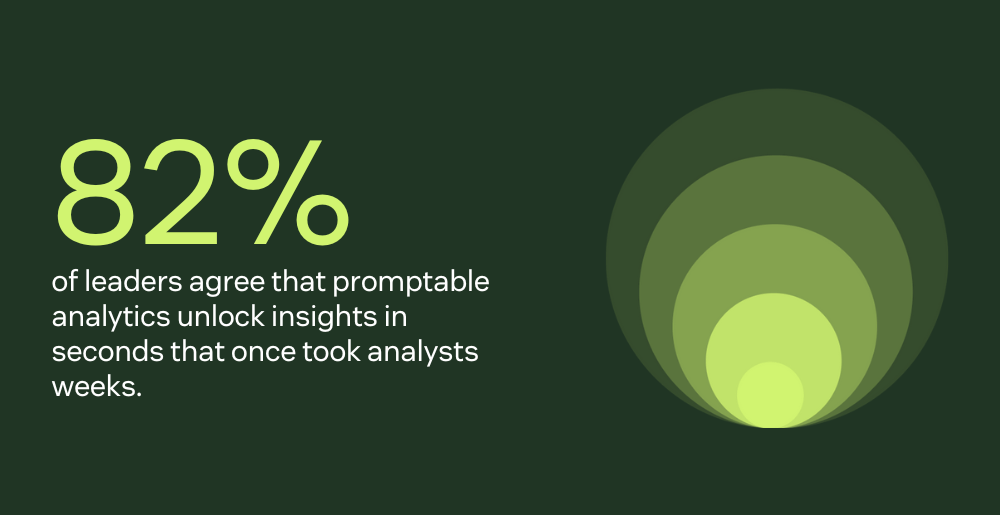
- Leaders are querying insights conversationally instead of building dashboards. This shift is already visible at scale. According to Zendesk’s 2026 CX Trends Report, 82% of leaders agree that promptable analytics unlock insights in seconds that once took analysts weeks.
This is more than a new input method. It mirrors Excel’s arrival, when everyone suddenly gained the ability to manipulate data without needing a database specialist. Today, anyone can direct intelligence without understanding the underlying model.
AI builders like Zendesk’s App Builder show that prompting is quickly becoming the default way to create. You can ask an AI to generate a prototype, design a workflow, or restructure a dataset with the ease of sending a text. The interface is conversation.
Just as Excel democratized access to data, prompting democratizes creation, analysis, and decision-making. It enables anyone, not just technical specialists, to generate ideas, prototypes, mockups, and insights within minutes. CX leaders increasingly recognize this: 81% say giving every employee the ability to ask questions will democratize decision-making.
Instead of waiting days for design resources, an admin can use their expertise to build apps that immediately improve service. A product manager can turn an idea into a prototype in minutes. A customer service leader can generate training materials from real tickets. A support agent can make a message more empathetic or policy-compliant with one instruction.
The gain isn’t speed alone; it’s reclaimed time to focus on customer needs, iterate on ideas, validate assumptions, and make decisions. Excel drove a similar shift by automating mechanical tasks so people could spend more time interpreting what the numbers meant.
4 tips for better AI prompting within the MAPS framework
When it comes to prompting, your ability to articulate what you want clearly and with context determines the quality of the output you receive. If natural language is the new interface, prompt literacy is the new core skill.
In prompting guidance for App Builder, we encourage users to:
Use clear and simple language
Be specific about desired functionality
Adopt an iterative mindset
Explain errors and fixes clearly
Applying these four steps within the MAPS framework helps structure prompts for clearer and more reliable outcomes.
MAPS stands for Mission, Action, Parts, and Scope: what you want the AI to achieve, what steps it should take, the ingredients it should use, and any boundaries it must follow. We also advise admins to use simple language, be specific about the desired functionality, and iterate as they go. These guidelines improve results, but they are not mandatory.
Consistency is key
Just like you’d find thousands of different recommendations for skincare routines, there’s no shortage of prompting frameworks and best practices. And the truth is the same in both cases: the specific routine matters far less than having one. The real advantage comes from developing a consistent, structured, and intentional way of directing the AI, and adjusting it over time when a new “serum” or technique comes along.
Good prompting resembles good management: set context, define constraints, ask for reasoning, request transparency, and encourage clarifying questions. Teams quickly learn that precision drives better outcomes, which is why many now build prompt libraries with shared templates and QA standards. And as more teams adopt prompt-driven interfaces, the infrastructure is maturing just as quickly. For example, 44% of firms already have a prompt-analytics hub live, a figure that is projected to nearly double to 86% in the next 12 months.
Developing expertise in a prompt-driven world
As natural-language interfaces mature, they are expanding, not replacing, the way people build expertise.
AI can accelerate how quickly this expertise forms. Zendesk’s Copilot, for example, surfaces relevant knowledge, similar tickets, and guided steps in real time. New agents gain exposure to best-practice reasoning from day one, helping them ramp up with confidence and focus on the work that truly benefits from human insight.
The goal is not to preserve older workflows. It is to extend and amplify the capabilities that matter most. CX leaders and agents remain responsible for the decisions that shape customer outcomes, and AI provides a stronger foundation for making those decisions.
The future interface is human-led
Prompting is quickly becoming the primary interface for AI. But the power remains human. When we prompt thoughtfully, AI becomes a collaborator that accelerates work, expands creativity, and improves decision-making. When we prompt poorly, it reflects our uncertainty back at us.
In customer service, a field defined by conversation, prompting feels like a natural next step. It enables more human responses, more intuitive workflows, and more intelligent service experiences.
The real skill is knowing what to ask.


