Article • 5 min read
What tech companies need according to Zendesk's 2026 CX Trends Report
The three capabilities tech companies need to stay competitive in an AI-driven service landscape.


Lindsay Murata
Product Marketing Manager
Última atualização em December 10, 2025


The tech industry has always moved quickly, but the pace of change today is unprecedented. As AI reshapes products and business models, client expectations are rising just as fast. Zendesk’s 2026 CX Trends Report confirms what many tech leaders already know: the future of service is intelligent, adaptive, and deeply personal.
For companies managing complex products and diverse customer needs, the pressure to adopt AI to resolve issues faster and tailor every interaction, and prove the ROI of new technologies has never been higher.
Every day at Zendesk, we see our tech customers tackling this pressure head-on, modernizing their service operations and reshaping how they support the people who rely on them.
Here’s how our tech customers are rising to the challenge and addressing the three most critical needs for 2026.
1. Accelerating resolutions and deflecting volume without the dev overhead
Lengthy resolution periods are a pain for everyone. Tech company clients wait too long for help. Customer Support Representatives (CSR) feel the strain as queues grow and work through complex products, specific Service Level Agreements (SLA) and deep technical troubleshooting that slow support down. Meeting the speed customers expect requires simplifying workflows and improving how teams work across systems.
This is where tech companies are investing in AI to streamline resolutions, reduce complexity, and improve resolution time. AI routes incidents more intelligently, automates repetitive troubleshooting, and provides support representatives with real-time guidance so they can work faster and more accurately — 91% of technology CX leaders say AI materially improves both first-reply and full-resolution times.
Zendesk’s customer Sinch, a global cloud communications platform, was struggling to manage the complexity of its growing, multi-brand support operation. They lacked a unified solution to make workflows efficient, which led to high support volumes and slow resolution times.
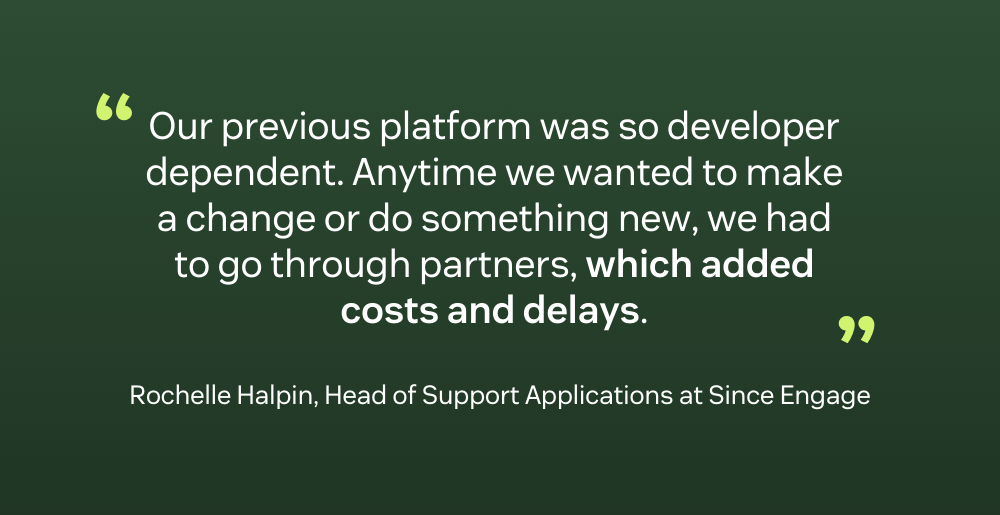
Sinch moved from a developer dependent platform to Zendesk. Its customer service was transformed by rebuilding its help center, implementing Zendesk’s AI agents to automate resolutions, and offering selected channels for VIP clients with defined SLAs. By shifting its primary channel to messaging with generative AI replies and enabling AI Copilot for human CSRs, Sinch created a cohesive, intelligent customer service flow. This use of a unified platform was the key to their efficiency gains.
The Outcome:
Sinch’s self-service automation rate nearly doubled—from 17 percent to 32 percent. Full resolution times improved by a massive 47 percent.
How Zendesk helps:
Zendesk provides a unified platform that strengthens self-service and gives support representatives the tools they need to work more efficiently with AI and automation. This foundation helps tech companies shorten time-to-resolution while maintaining high-quality support as they scale.
2. Personalizing support to drive customer retention
Tech clients expect support that is fast, relevant, and grounded in an understanding of who they are. Personalization creates that connection, making clients feel valued and driving long-term loyalty. But achieving it at scale is challenging for tech companies, especially when managing large user bases and complex product portfolios.
Persistent memory is becoming a core CX investment for 2026 because it gives support teams and AI agents the full context they need to deliver accurate, empathetic, and tailored guidance. The impact is clear: 90% of technology CX leaders say memory-rich AI agents are essential for truly personalized journeys, and 87% say persistent memory helps build deeper, longer-lasting customer relationships.
Auctane, which specializes in shipping and logistics solutions for e-commerce with brands like ShipStation and Stamps.com, faced the massive challenge of delivering a personalized, consistent experience across its 11 brands. As its leader, Karp, put it: “The main challenge is figuring out how to deliver a one-size-fits-one experience to millions of customers, across millions of interactions, and make every one of them feel personalized.”
Auctane leveraged Zendesk’s unified data model to customize the experience at scale. This meant arming CSRs with the historical customer persona information they needed to provide proactive, tailored support. Customer support representatives could also be proactive. For instance, they see a negative NPS or CSAT score and immediately kick off a conversation to address the issue before the customer even raises a ticket.
The Outcome:
Auctane achieved its goal of delivering a customized experience that scales across its entire portfolio of brands, cementing relationships and loyalty.
How Zendesk helps:
Zendesk’s platform is built on Contextual Intelligence, giving both human CSRs and AI the memory needed to understand each customer’s full story and reduce repetitive questions.With AI, tech companies can create personalized interactions that engage customers and strengthen their relationships.
3. Amplify ROI from AI investments
Investments in AI customer service tools are accelerating as tech companies automate workflows, streamline incident management, and deliver 24/7 personalized support. These capabilities translate directly into faster resolutions, lower operating costs, and higher customer satisfaction—creating a proven, repeatable path to ROI. With results already materializing, CX leaders are doubling down: 92% of technology CX leaders plan to increase their AI investments for customer service in the next year, and 94% report positive ROI from their AI investments over the past 12 months.
INSHUR, an insurtech company undergoing rapid expansion, saw its customer volume increase tenfold and made a strategic choice: instead of hiring more CSRs, it would empower its customers. They needed a measurable way to scale their support model.
INSHUR launched a help center using Zendesk Knowledge and a self-service first approach. To mitigate any risk of deflection, they used Zendesk Analytics to gain real-time visibility into the performance of self-service and automation efforts, as well as Zendesk QA to monitor 100% of interactions. This data-driven approach enabled faster iteration and confident decision-making, allowing them to scale support without a proportional increase in headcount.
The Outcome:
The number of active customers reaching out to an agent dropped dramatically from 65% to just 14%. This efficiency reduced their cost per ticket by 30%.
How Zendesk helps:
Zendesk provides the end-to-end platform for AI implementation and measurement. By coupling a powerful self-service channel and real-time performance insights, tech leaders can track the cost-saving and loyalty benefits of their AI strategy.
In the dynamic technology industry, staying ahead means mastering the client experience. By strategically investing in Zendesk’s platform to deliver accelerated resolution, memory-rich personalization, and measurable ROI, tech leaders aren’t just reacting to change—they are building a durable, customer-centric strategy that is definitively ready for 2026 and beyond.